
Marriage, a sacred institution deeply embedded in Christian theology, originates from the biblical narrative. Christian doctrine holds that marriage is not merely a social contract but a divinely instituted covenant reflecting God’s relationship with humanity. This article explores the origins, development, and purposes of marriage within a Christian context and provides scriptural support to illustrate its significance for believers today.
The Origin of Marriage
The foundation of marriage is established in the book of Genesis, where God instituted it as the first social institution. Genesis 2:18-24 states: “The Lord God said, ‘It is not good for the man to be alone. I will make a helper suitable for him.’ But for Adam no suitable helper was found. So the Lord God caused the man to fall into a deep sleep; and took one of the man’s ribs. The Lord God made a woman from the rib he had taken out of the man and brought her to him. The man said, ‘This is now bone of my bones and flesh of my flesh; she shall be called ‘woman,’ for she was taken out of man.’ This is why a man leaves his father and mother and is united to his wife, and they become one flesh.”
This passage introduces the terms “helper” (בֹּוֵן) and “cleave” (דָּבַק). These terms highlight two key aspects of marriage’s fundamental reality and purpose: first, the complementary nature of the sexes, and second, God’s intention for marriage to encompass physical, emotional, and spiritual union. Additionally, Genesis 1:28 reveals a third purpose for marriage when God commands the couple, “Be fruitful and multiply; fill the earth and subdue it.”
Development of Marriage in Scripture
Marriage evolves and is enriched in various contexts throughout the Old and New Testaments. For the Jewish people, marriage was often depicted as a covenantal partnership emphasizing faithfulness, love, and commitment. For example, Malachi 2:14 describes marriage as a covenant before God: “You ask, ‘Why?’ It is because the Lord is the witness between you and the wife of your youth. You have been unfaithful to her, though she is your partner, the wife of your marriage covenant.” Similarly, in the New Testament, Jesus affirms the sanctity and intended permanence of marriage in Matthew 19:4-6: “Haven’t you read that at the beginning the Creator ‘made them male and female,’ and said, ‘For this reason, a man will leave his father and mother and be united to his wife, and the two will become one flesh’? So they are no longer two, but one flesh. Therefore what God has joined together, let no one separate.”
These passages emphasize the unbreakable bond established in marriage and reflect God’s desire for couples to live in loving, committed relationships for their lives.
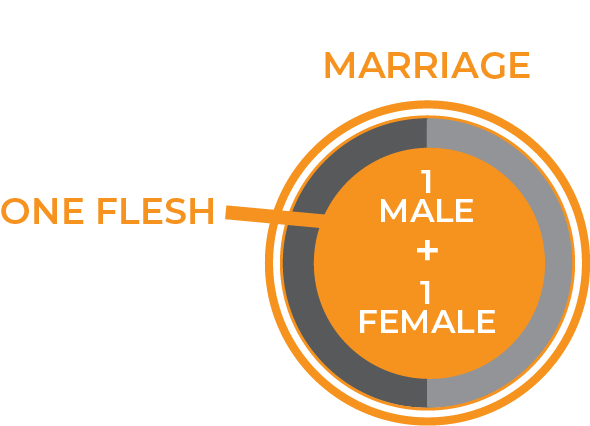
The Picture of Marriage
Christians view several images in the marital union between a man and his wife. First, as mentioned, Genesis portrays a husband and wife complementing each other throughout life’s journey. Second, Ephesians 5:25-32 compares marriage to the relationship between Christ and his church. The husband’s actions reflect Christ’s sacrificial love, while the wife’s love and intimacy illustrate the church’s devotion to Christ.
Additionally, the marriage covenant signifies procreation, representing stability and love within a family. It reminds us of God’s family in heaven and on earth, looking forward to future fulfillment when all creation will be restored and sin erased. Lastly, marriage serves as a testimony of fidelity, depicting God’s love for creation. As stated in John 3:16, “For God so loved the world that He gave His only begotten Son, that whoever believes in Him should not perish but have everlasting life.” Covenantally bound couples witness God’s love and grace and illustrate the permanence of God’s character and promises.
C.S. Lewis, in “Mere Christianity,” wrote that the purpose of marriage is to foster sanctification and the development of virtue, asserting, “There is no such thing as a good marriage in which the chief aim of the husband and wife is to possess each other.” Similarly, Tim Keller, in “The Meaning of Marriage,” highlights the transformative power of marriage as a covenant relationship designed for mutual growth and reflection of God’s love.

Conclusion
Marriage, as understood within the Christian tradition, is a sacramental union embodying God’s design for human relationships. Rooted in the creation story, it has evolved through scriptural teachings to reflect purposes beyond personal fulfillment—serving as a means of grace, mutual support, and a witness to a fallen world. As couples navigate life’s complexities together, they are reminded of their vital role in this divine covenant, reflecting Christ’s love in their union.
As Christians continue to live out this sacred calling, the importance of grounding marriage in scripture and theological insight remains crucial, guiding believers toward a deeper understanding and appreciation of the marriage covenant.
Over the course of this next year we will explore many aspects of the institution we call marriage, from this introduction, to where we can find it in the Old Testament and in the New Testament, what the biblical roles are for both Husband and Wife, what is the differences between contractual and covenant relationship, exploring the biblical definition of marriage today, what the cultural ramifications are for marriage, how the church should view marriage, practical advice for those preparing for marriage, as well as advice for those who are neck deep in it, how to deal with the stark realities of divorce and re-marriage in today’s world, and lastly, what the future might hold for the institution of marriage itself.
We hope you will join us on this journey to explore what marriage is, what it could be, and how we can get there from where we are today. Subscribe to this blog so you can be alerted when the next part of this series is posted.

Please join us each Sunday at Harbor Baptist Church for fellowship, our main 10:30 AM Service, Sunday School (9:30 AM), and at our various Small Groups throughout the week.
 Harbor Baptist Church
Leave a comment